ResilienceLink: AI-Powered Disaster Alert & Coordination
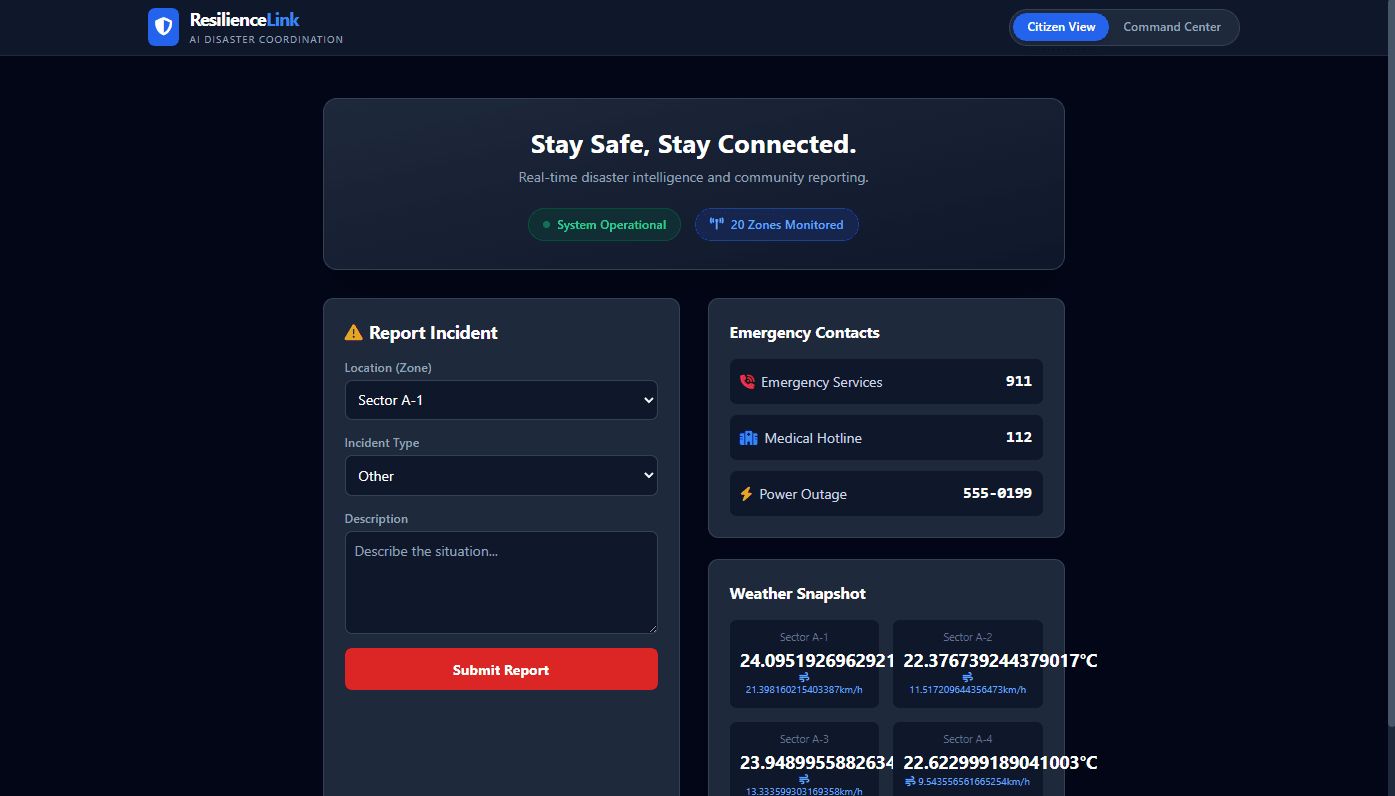
An AI-powered platform for disaster preparedness and response, utilizing environmental data and the Gemini API for real-time threat analysis and location-based alerts.
ReactTypeScriptNext.jsNode.jsPostgreSQLPrismaTailwind CSSGraphQLDockerAWSGemini APIPostGISWebSockets (Socket.io)Geospatial
ResilienceLink: AI-Powered Disaster Alert & Coordination Platform
Overview
ResilienceLink is a sophisticated platform meticulously designed to significantly enhance disaster preparedness and response mechanisms. By leveraging cutting-edge Artificial Intelligence, specifically the Gemini API, the platform excels at risk prediction and facilitates real-time communication during critical events. It goes beyond typical portfolio applications by directly addressing complex real-world challenges in environmental sustainability and disaster management.
Tech Stack
Challenges
Learnings
Development Roadmap
Phase 1
1. Project Setup & Core Infrastructure: Initialize Next.js monorepo, Node.js backend with GraphQL server, and PostgreSQL database with PostGIS extension. Set up Prisma ORM.
Phase 2
2. Database Schema Design: Define models for users, locations (using PostGIS geometries), disaster types, alerts, environmental sensor data, and incident reports. Implement spatial indexing.
Phase 3
3. Authentication & Authorization: Implement secure user authentication (e.g., NextAuth.js for frontend, JWT for backend) with roles for citizens, responders, and administrators.
Phase 4
4. Geospatial Data Services (Backend): Develop GraphQL API endpoints to store, retrieve, and perform spatial queries on location data (e.g., users' safe zones, disaster zones, sensor locations) using PostGIS functions.
Phase 5
5. Environmental Data Ingestion: Create an API for ingesting simulated or real-time environmental sensor data (temperature, water levels, air quality, etc.).
Phase 6
6. Gemini AI Integration for Risk Analysis: Develop a Node.js service that utilizes the Gemini API to analyze incoming environmental data, identify patterns, predict potential disaster risks, and generate concise, actionable insights.
Phase 7
7. Real-time Alerting System (Backend - WebSockets): Implement a WebSocket server (using Socket.io) in Node.js. This server will push immediate alerts and updates to clients based on their registered locations and proximity to identified threats.
Phase 8
8. Frontend Development - Citizen Dashboard: Build a Next.js application with React and Tailwind CSS. Implement a user dashboard displaying personalized, real-time alerts on an interactive map (e.g., Leaflet or Mapbox GL JS), incident reporting functionality with location tagging, and safe route suggestions.
Phase 9
9. Frontend Development - Responder/Admin Dashboard: Develop a separate interface for emergency services. This dashboard will provide an overview of active incidents, affected areas, resource allocation, and real-time communication channels (via WebSockets) for coordination.
Phase 10
10. Deployment & Scalability: Dockerize all services (Next.js app, Node.js backend, PostgreSQL). Deploy to AWS using services like ECS/EKS for containers, RDS for PostgreSQL, S3 for static assets, and implement CI/CD pipelines for automated deployments.
Phase 11
11. Testing & Refinement: Conduct thorough unit, integration, and end-to-end tests. Optimize performance for real-time updates and complex geospatial queries. Gather user feedback for UI/UX improvements.